Notes from the Field: Smelling the Past at the Mary Todd Lincoln House
As more museums explore multisensory interpretation, scent is emerging as a powerful—yet still untypical—tool for storytelling. In this edition of Notes from the Field: How Museums Use Olfactory Storytelling, we feature the Mary Todd Lincoln House in Lexington, Kentucky, and their exhibition interactive Smell the Past: Scent Interactive. This case study offers a clear and practical example of how a historic house museum thoughtfully integrated scent to help visitors imagine the past.
A big thank you to the team at the Mary Todd Lincoln House for generously sharing their process, challenges, and reflections, allowing others to learn from their experience.
Are you working with scent at your cultural institution and want to be featured on my blog? I am happy to hear about your experience! Please reach out to me using my contact page.
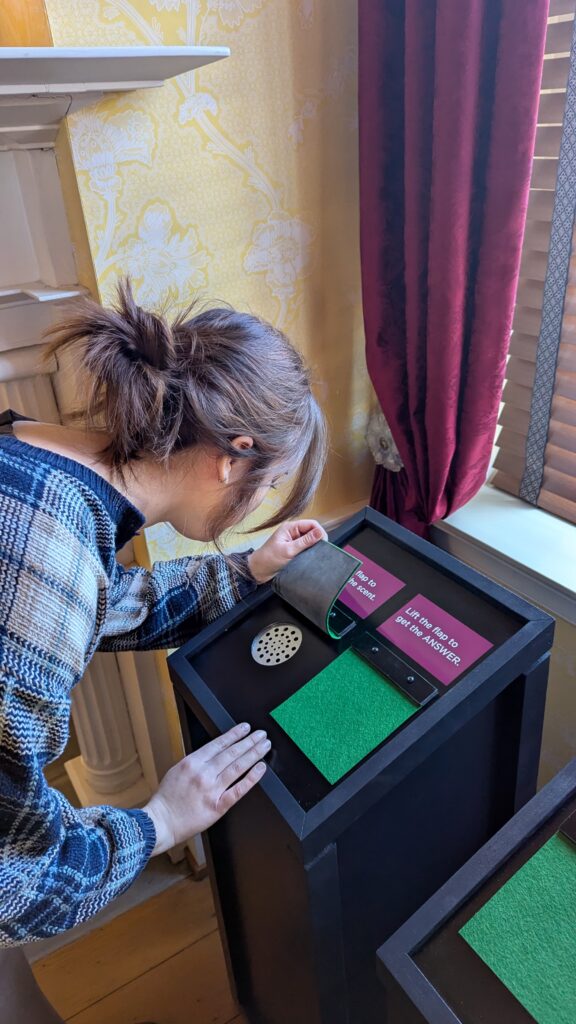
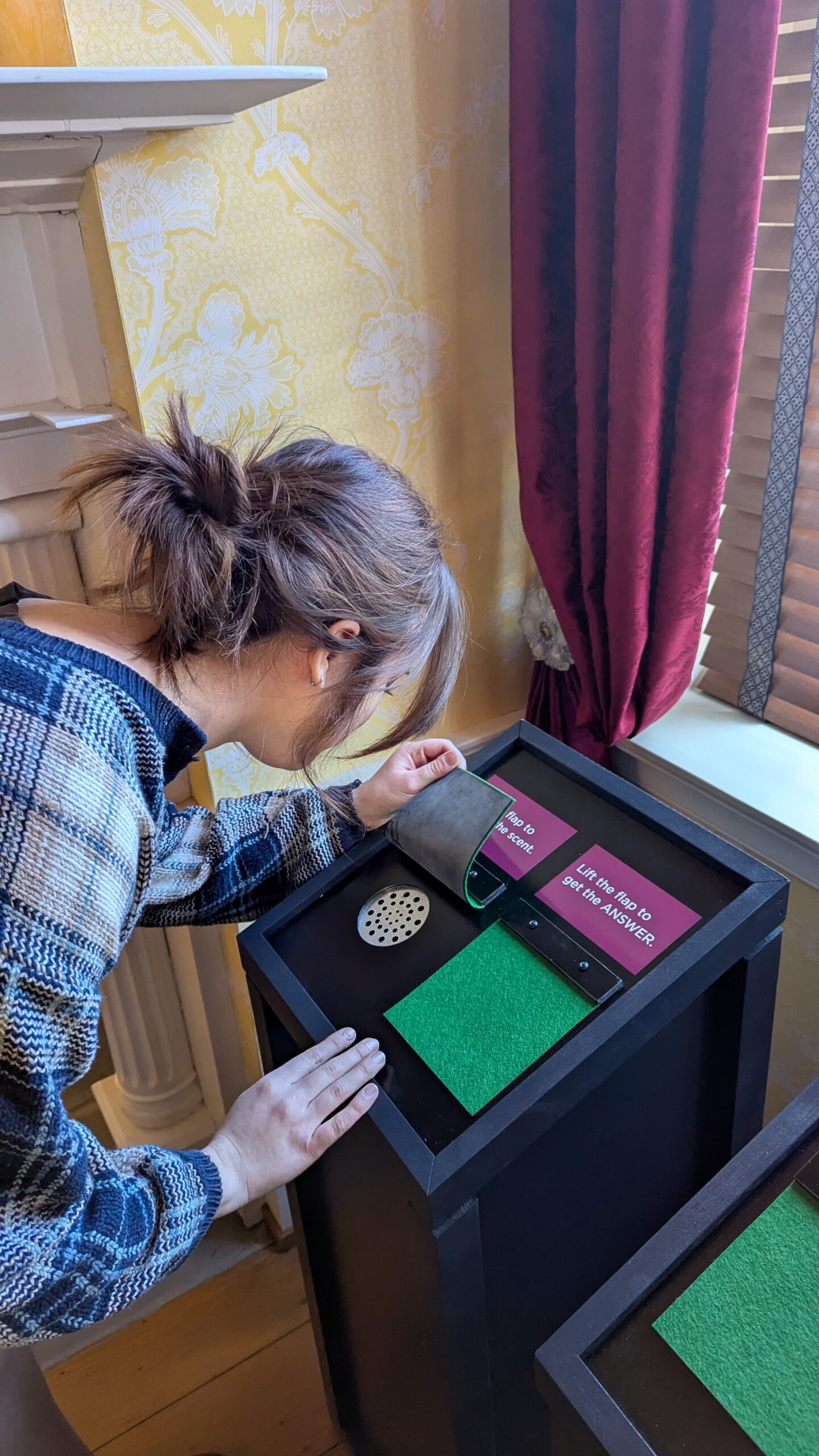
Visitor using scent interactive. All photos courtesy of and taken by Kate Hesseldenz. (2025)
Smell the Past: Scent Interactive Overview
The Mary Todd Lincoln House is the childhood home of Mary Todd Lincoln, located in downtown Lexington. Built between 1803–1806, it is the only structure of its age still standing in the immediate area, which is now surrounded by modern development and large-scale construction projects. This changing cityscape presents the institution with an interpretive challenge: how do you help visitors imagine a 19th-century neighborhood that no longer exists?
- Institution: Mary Todd Lincoln House
- Location: Lexington, Kentucky
- Project: Smell the Past: Scent Interactive
- Duration: 4 months
- Number of Scents: 4
- Project Members: Gwen Thompson (Museum Director), Vicky Middleswarth (Education Coordinator), Kate Hesseldenz (Assistant Director) and Travis Robinson of Exhibits Work (contract exhibit designer).
Why Scent?
The idea to incorporate scent emerged during the development of a new interactive made possible through grant funding. The museum’s director proposed scent as a way to deepen visitor engagement and help visitors better imagine the neighborhood as it existed during the Todd family’s residency.
During the Todd family’s time, the property spanned three city lots. It was an urban area with homes, factories, and the Lexington Brewery next door. Their property had several outbuildings, including a stable, and a flower garden. Today, the museum occupies just one lot within a highly modernized downtown landscape. The scent interactive offered a way to bridge this juxtaposition of history and modern development. Smell acted as a vehicle to help visitors imagine the sensory environment of early 19th-century Lexington.
It was important that the scent interactive also aligned with the museum’s central topics: “Todd family background,” “slavery,” “education,” the “Civil War,” and “personal tragedies.” Installed in the family parlor, the scent units support the “Todd family background” theme by relating the scents to Mary Todd Lincoln’s youth and identity.
Identifying the Olfactory Narrative
The museum’s olfactory narrative was simple and effective: What is the smellscape of early Lexington and of the Todd’s home?
Four scents and materials were selected:
- Hops – referencing the Lexington Brewery that was located next door to the Todd family home;
- Hay – recalling the Todd family’s stable and horses;
- Lilac – inspired by a lilac hedge that was located in the family garden;
- Smoke – representing the wood-burning fireplaces, stoves, and nearby industry that defines the neighborhood.
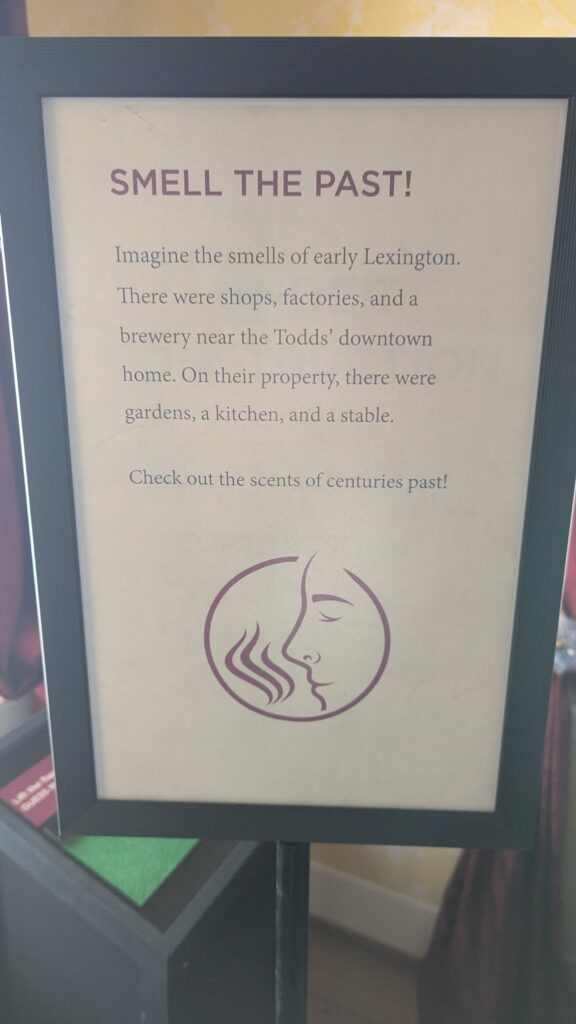
Main scent interactive label.
Sourcing Scents & Maintaining Historical Accuracy
One of the biggest challenges the team faced was sourcing scents that were historically appropriate. They ultimately sourced lilac and smoke fragrance oils from candle and soap suppliers but found that many off-the-shelf scents smelled too good or too perfumed to feel historically believable. For hops and hay, the museum chose to use the actual materials rather than synthetic reproductions, as no fragrance oils adequately captured the smell of a brewery or stable.
An important part of the scent sourcing process was trial and error in preparation for the scent distribution design. The designer made a prototype unit, which was set in the room for a month. Docents were brought in to interact with the unit and asked to blindly smell each scent and guess what it was. This process ensured that the scents were recognizable, easily identifiable to visitors, and perceivable in the chosen design method.

All four scent interactive units in its room setting.

Unit with lid up showing hay material
underneath.
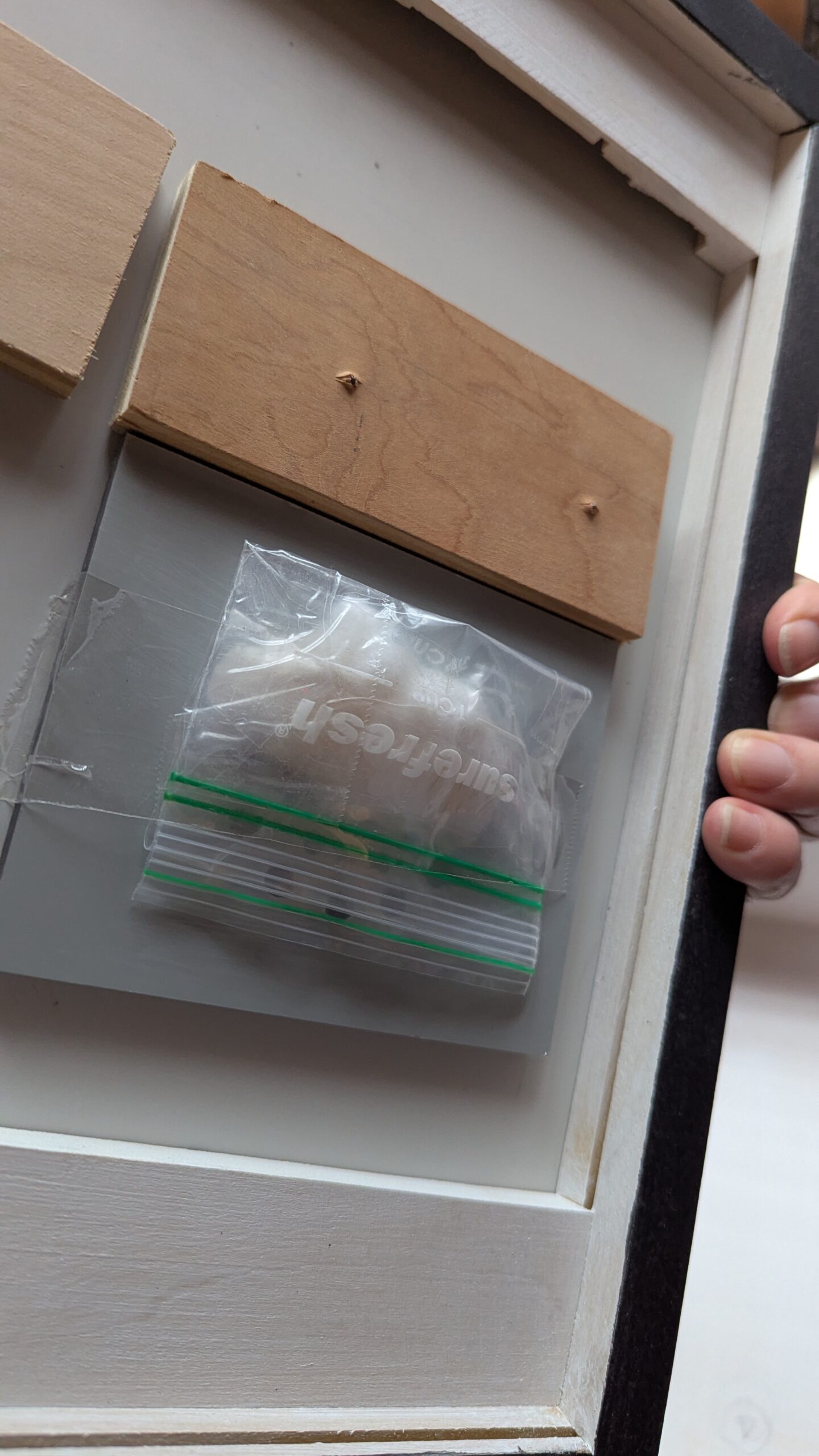
Unit with lid up showing cotton balls
with fragrance oil underneath.
Scent Distribution Design
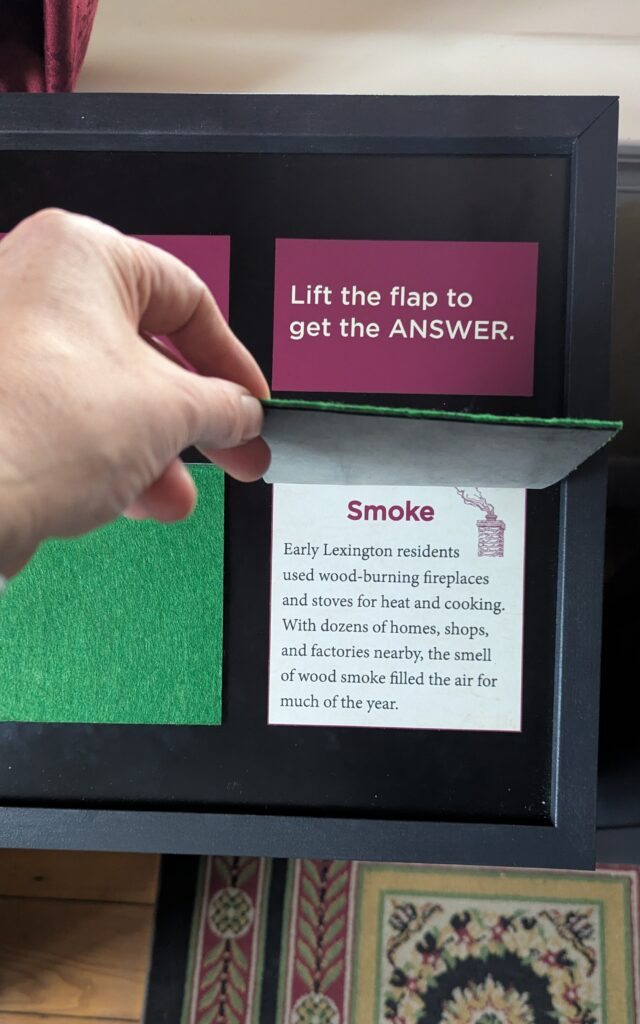
The scent interactive consists of four standalone stations with perforated metal lids. Visitors are invited to smell each scent and guess what it is before lifting a flap to reveal the answer and historical context. This turned the experience into both a sensory and interpretive exercise.
Scents are placed beneath the metal and covered with felt until a visitor actively chooses to smell—an approach that supports visitor agency and helps control scent disbursement.
- The material of hay and hops were placed directly under the metal;
- Fragrance oils were applied to cotton balls taped underneath the metal lids. The number of cotton balls necessary to be perceivable depended on the scent. For example, the smoke scent only required one cotton ball while the lilac needed two.
Standalone, mobile units were chosen deliberately, which allowed staff to move them if scents overlapped or drifted too much. This flexibility proved effective: although the units are currently close together and the museum have not experienced issues with scent overwhelm or overlapping.
Each station includes clear signage:
- A main label explaining the interactive;
- Instruction labels guiding how to engage;
- Icons signaling the presence of scent.


Visitor Experience & Accessibility
While formal impact evaluation has not taken place, early visitor reactions have been positive. Many visitors enjoy guessing the scents, and several have remarked that they have not encountered this type of interaction in other US museums.
Accessibility and potential allergies were addressed through:
- Clear visual indicators and signs that informed visitors that scent is included in the installation;
- Docents proactively inform visitors that scent is present;
- Participation is optional and the distribution gave visitors agency and the choice to sniff or not sniff.
The museum shared that visitors could most easily identify the smoke scent, while hay and hops proved more challenging.
Challenges & Lessons Learned
The museum team emphasized one key takeaway for institutions interested in olfactory storytelling: plan for scent sourcing early. Historically accurate scents—particularly those that are not conventionally “pleasant”—can be difficult to find, and limited availability may significantly shape both the scope and timeline of a project.
This challenge is especially pronounced for institutions working within modest budgets. Access to historically relevant, affordable scent materials remains a major gap in the United States, underscoring the need for more accessible solutions and shared resources.
The team also highlighted the importance of prototyping. Testing a single scent unit in one of the room settings helped confirm that the design was intuitive, effective, and appropriate for the space before full implementation.
Final Reflections
This case study highlights an important aspect about olfactory storytelling: meaningful scent-based interpretation does not always require large budgets or bespoke perfumery to be effective. Thoughtful research, careful testing, and a willingness to experiment can go a long way—and sometimes, looking at everyday materials or even your pantry is enough to spark compelling olfactory narratives.
By openly sharing both their successes and challenges, the team at the Mary Todd Lincoln House offers valuable, practical insight into what it looks like to integrate scent into a historic house museum context. Their experience demonstrates that thoughtful research, testing, and experimentation can go a long way for olfactory storytelling. Through this dedication, they contribute to a growing body of knowledge within olfactory museology and help pave the way for other museums and historic sites that are curious about using scent to deepen engagement and bring the past to life in new, sensory ways.
Interested in Learning More?
Interested in learning more? Make sure to check out my blog post on Recommended Smell Culture Resources to dive deeper into the world of olfactory museology and become familiar with more trailblazers of this field.
I regularly teach courses about Olfactory Storytelling and Olfactory Museology with the Fragrance Alliance Network. Make sure to stay up to date with when I am teaching next or where my projects will be exhibited by joining my mailing list here.
Is your museum working with scent? I would love to feature your story! Reach out to me through my contact page here.