Celebrating 1 Year at The Olfactory Contractor
When I founded The Olfactory Contractor, I was responding to a gap.
There was a growing body of research demonstrating the value of smell in culture, history, and heritage. Museums were becoming increasingly interested in multisensory interpretation. Perfumers, historians, scientists, curators, designers, and educators were already contributing valuable expertise. But there were still very few people focused on connecting those areas and helping institutions turn research about smell into responsible, meaningful public experiences.
There was no established job title for the work I wanted to do, so I created one.
One year later, The Olfactory Contractor has become more than a consultancy. It is helping define Olfactory Museology as a professional practice in its own right.
Why I Started The Olfactory Contractor
Scent is often introduced into exhibitions as atmosphere, novelty, or immersion. My work begins with a different question:
What can scent help visitors understand?
That question changes the entire process. The work is no longer simply about deciding what an exhibition should smell like. It becomes a form of interpretation requiring research, planning, transparency, accessibility, visitor choice, and collaboration.
An olfactory museologist helps identify where scent can contribute meaningfully to an exhibition or public program. My role is to translate research into an interpretive strategy, develop the scent concepts and briefs, coordinate the people needed to realize them, and help determine how visitors will encounter the finished work.
That meeting point between historical research, museum interpretation, scent development, and visitor experience is not a gap between disciplines. It is the expertise itself.
A Year of Putting Olfactory Museology into Practice
The past year has allowed me to explore what scent can contribute across museums, historic collections, live events, public programs, and community spaces.
Each project has been very different, but the principle has remained consistent: scent should not be added simply because it is memorable or immersive. It should contribute knowledge, focus attention, encourage curiosity, or provide another way into a story.
Interpreting 100 Years of Route 66
October 17th, 2026 - December 16th 2026 | Yucca Valley, California
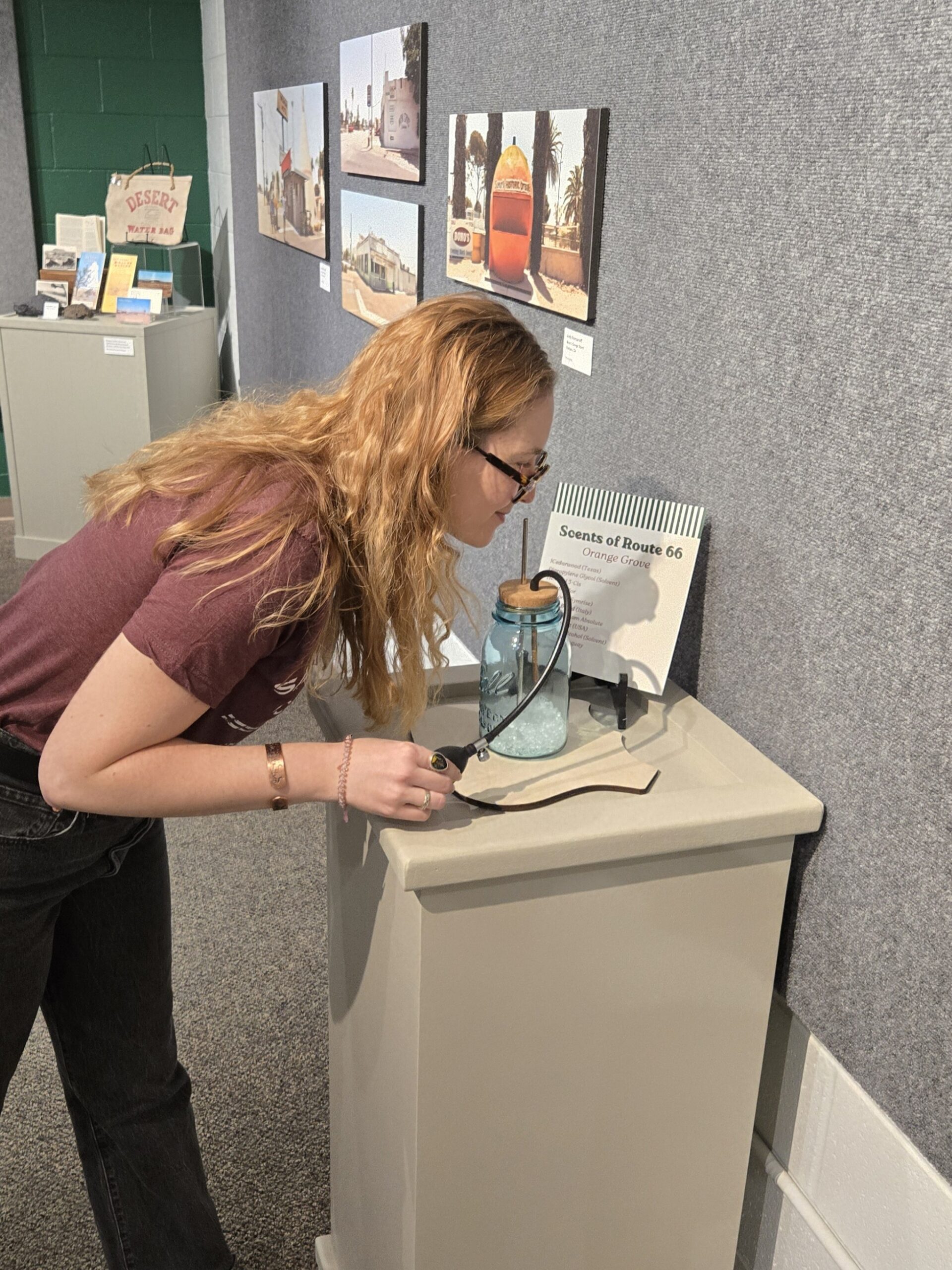
One of the year’s most significant projects was The Journey Is the Destination: 100 Years of Route 66, which just opened this week at the Hi-Desert Nature Museum in Yucca Valley, California.
The goal was not to make the gallery smell like Route 66. Working with the museum’s collection and exhibition stories, I developed themes that could reveal different aspects of the road’s landscapes, cultures, and lived experiences. Those themes then informed the scent concepts and the creative work of the perfumer, Alie Kiral of Pearfat Parfum.
Visitors encounter the scents through individual jars rather than ambient diffusion. This keeps each smell connected to a particular interpretive moment and allows visitors to decide whether and when they want to participate.
The project demonstrates all four ideas at the center of my practice: scent can communicate knowledge, its use requires a responsible method, the finished experience depends on collaboration, and specialized olfactory expertise has an important place on the museum project team.
I will be giving a free in-person lecture, Discovering the Sensory Heritage of Route 66 on November 14th, 2026 at 2PM. More info HERE.
Making Sense of Maryland’s History
Permanent | Baltimore, Maryland
At the Maryland Center for History and Culture, Wayfinders: Making Sense of Our World offered another opportunity to consider how smell can support learning.
The permanent exhibition invites children and families to explore how people make sense of the world through sight, sound, touch, and smell. Working with the museum team, designers, and fragrance partners (Gus Romero), I developed an olfactory interpretation strategy that connected scent to the exhibition’s educational goals.
The resulting experience includes 11 bespoke scents inspired by the people, places, objects, and events of Maryland history. One scent interprets the environment represented in Charles Willson Peale’s Exhumation of the Mastodon. Instead of merely reproducing an individual object depicted in the painting, it evokes the atmosphere of the excavation and offers visitors a new way of approaching the work.
The exhibition does not simply engage the senses. It encourages visitors to think about perception itself, including how our sensory experiences and biases shape what we notice, remember, and understand.
Exploring Sulfur with Radiolab NYC
Occasional Showings | New York City
Scent can also help an audience reconsider something it believes it already understands.
For Radiolab’s Viscera: Gripping Tales of the Human Body, I worked with perfumer Gus Romero of the Fragrance Alliance Network to develop three sulfur-inspired scents.
Sulfur is commonly associated with danger, decay, and offensive odors. The program, however, explored a much more complicated story, moving through the human body, medicine, the battlefield, and outer space.
Our challenge was to make sulfur perceptible and thought-provoking without making the audience physically uncomfortable. It was an unusual balancing act between accuracy, interpretation, theatrical storytelling, and audience experience. It also demonstrated that an unpleasant smell can be an effective educational medium when audiences understand why they are encountering it.
Taking the Conversation to Europe
My travels in Europe last month expanded the year’s work beyond individual projects and into a larger conversation about smell, culture, technology, and public engagement.
In Amsterdam, I collaborated with Arielle Tai of Scentered Workshops on the lecture The Smell of History: Scent, Identity, and Culture, hosted by Think & Drink. The event brought olfactory heritage into a lively public setting.
In Paris, I explored the city’s smell culture and documented the experience of sending a scented postage stamp. Experiences like these offer more than entertaining travel content. They reveal how scents circulate through everyday life and how objects, brands, transportation, commerce, and public rituals contribute to the sensory identity of a place.
At IAAPA, my visit with AromaPrime also provided an opportunity to consider the sophisticated ways themed entertainment uses scent, and what museums can learn from an industry with substantial experience in scent delivery, technology, maintenance, and audience response.
These conversations are important because responsible olfactory practice cannot develop inside one professional silo. Museums, fragrance professionals, researchers, designers, educators, and experience creators all hold different parts of the knowledge we need.
Creating Spaces for Shared Learning
Using Smells in Museum Event (online)
This year has also reinforced the importance of education and professional exchange.
During International Themed Smell Day, I worked with Liam Findlay to present the online program Using Smell in Museum (purchase the recording here). The program created a space for practitioners to discuss how museums are already employing scent and to share the practical knowledge that can otherwise remain hidden within individual projects and professional networks.
This matters because there is still no clear pathway into olfactory museology. There are very few formal courses, internships, job titles, or professional development opportunities created specifically for people who want to work with olfactory heritage.
If the field is going to grow, access to its knowledge cannot depend solely on knowing the right person or happening upon the right project.
New Classes with the Fragrance Alliance Network
To help create more accessible entry points, I am teaching two online courses with the Fragrance Alliance Network, each offered twice during the coming months.
Scent as Interpretation: A Brief Introduction to Olfactory Heritage & Museology
This one-hour class provides a concise introduction to olfactory heritage and olfactory museology. It considers why smell matters as part of our cultural and historical record, how scent can communicate knowledge, and what opportunities and challenges arise when it is used for public engagement.
Upcoming sessions:
- November 21, 2026 from 1:00 to 2:00 p.m EST (Purchase Tickets HERE)
- January 30, 2027 from 1:00 to 2:00 p.m EST (Purchase Tickets HERE)
- One hour
- $60
Scent as Interpretation: Building a Foundation in Olfactory Heritage & Museology
This 2.5-hour course offers a deeper exploration of theory, research, and professional practice. Through museum and cultural heritage case studies, participants will examine interpretation, accessibility, ethics, visitor choice, and practical approaches to developing olfactory experiences.
Upcoming sessions:
- December 12, 2026, from 1:00 to 3:30 p.m (Purchase Tickets HERE).
- February 20, 2027, from 1:00 to 3:30 p.m (Purchase Tickets HERE).
- $150
Both courses are open to museum professionals, educators, designers, researchers, heritage practitioners, students, perfumers, and curious learners. No previous knowledge of museums, heritage practice, or perfumery is required.
These classes are not only about teaching people to use scent. They are part of a larger effort to establish a shared vocabulary, stronger professional standards, and more visible pathways into the field.
What Comes Next?
As I enter the second year of The Olfactory Contractor, my goal is to continue developing meaningful olfactory interpretation while also strengthening the infrastructure surrounding the work.
That means creating new educational opportunities, documenting methodologies, sharing case studies, making the collaborative process more visible, and demonstrating why an olfactory museologist should be a valued member of a museum or cultural project team.
The field does not only need more scented exhibitions. It needs specialists who understand how to determine when scent is appropriate, what it should communicate, where evidence ends and interpretation begins, how visitors will encounter it, and which collaborators are needed to bring an idea into practice.
There was no job title for the work I wanted to do, so I made one. My ambition is that the next person will not have to.
A new platform for engaging with Olfactory Heritage is coming soon. Stay Tuned.
Do not hesitate to reach out via my contact page if you have questions.